Agentic Workflow Design
Agentic AI Recovery System for Airline Disruptions
AI system that helps airline passengers recover from disruptions while giving agents reviewable, controllable AI-recommended actions.
Role
UX Research, Conversation Design, Interaction Design
Tools
Figma, Qualitrics
Type
Independent concept project
Duration
3 Weeks
OVERVIEW
When a flight gets delayed, the airline already knows almost everything it needs to help you — your connection, your bag, your odds of making it. It just has no way to tell you in time.
I designed an AI-powered disruption recovery system for a fictional airline, Altitude Air —one system, two surfaces: a disruption command center for operations agents, and a conversational recovery assistant for passengers, Altitude AI. Same AI reasoning, expressed differently depending on who's looking at it.
THE PROBLEM
Airlines have the data. They don't have the interaction layer to deliver it in time.
7,000 flights cancelled, 1.4M passengers disrupted — Delta's 2024 CrowdStrike outage, when crew-tracking failures forced recovery decisions to be made by hand. Source: Reuters, via Wikipedia →
16,700 flights cancelled in 10 days — Southwest's 2022 holiday collapse, when crew-scheduling software couldn't keep pace once winter storms broke the network. Source: NPR →
148,479 bags mishandled in a single month — November 2025 alone. Passengers with wheelchairs and mobility devices were mishandled at more than double that rate. Source: DOT Air Travel Consumer Report →
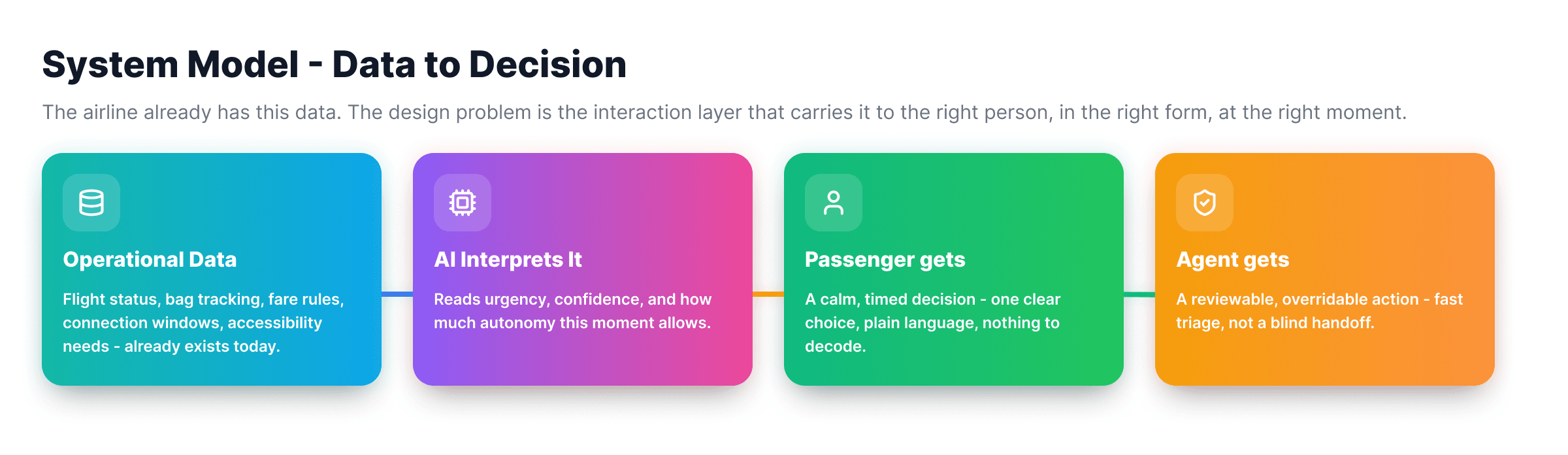
So the design problem is narrower than "airlines need better AI." Airlines already have the intelligence. What's missing is an interaction layer that knows how much autonomy to use, when to ask permission, and how to fail without abandoning the person in the middle of it.
RESEARCH
Research signals that shaped the problem
I used secondary research to understand whether airline disruption recovery is mainly an information problem, an operations problem, or an interaction problem. Three signals stood out: passengers increasingly expect mobile self-service, airline recovery operations can break under fragmented systems, and disruption recovery includes baggage, vouchers, and accessibility needs — not just rebooking.
EVIDENCE 01
Mobile is the right passenger surface
78%
want one unified travel app
IATA’s 2025 Global Passenger Survey shows that passengers are increasingly managing their journey through smartphones. One key finding: 78% of passengers want one app combining their digital wallet, passport, and loyalty cards. This supports mobile as the right surface for disruption recovery — but not as proof that passengers want full AI autonomy. The design challenge is to introduce AI gradually, with clear status, explanation, and approval.
IATA Global Passenger Survey 2025
EVIDENCE 02
Recovery breaks when tools are fragmented
17K
flights cancelled in one collapse
Major airline disruptions show how quickly recovery can fail when operational decisions depend on disconnected systems. Delta’s 2024 CrowdStrike-related disruption led to about 7,000 cancelled flights affecting roughly 1.4 million passengers. Southwest’s 2022 holiday collapse showed similar fragility: winter storms combined with outdated crew-scheduling technology contributed to nearly 17,000 cancelled flights.
Reuters · AP News
EVIDENCE 03
Recovery is more than rebooking
88%
want real-time luggage tracking
DOT’s Air Travel Consumer Reports track not only flight delays, but also mishandled baggage, wheelchairs, and scooters. A passenger is not truly recovered if the flight is rebooked but the bag, voucher, or mobility device is unresolved. IATA also found that 88% of passengers would feel more confident if they could track luggage in real time, reinforcing baggage visibility as a core recovery need.
U.S. DOT Air Travel Consumer Reports · IATA GPS 2025
Sources reviewed: IATA Global Passenger Survey 2025; U.S. DOT Air Travel Consumer Reports; Reuters coverage of Delta’s 2024 CrowdStrike disruption; AP News coverage of Southwest’s 2022 holiday operational collapse.
Sources reviewed: IATA Global Passenger Survey 2025; U.S. DOT Air Travel Consumer Reports; Reuters coverage of Delta’s 2024 CrowdStrike disruption; AP News coverage of Southwest’s 2022 holiday operational collapse.
BEFORE STATE/ CURRENT EXPERIECNE AUDIT
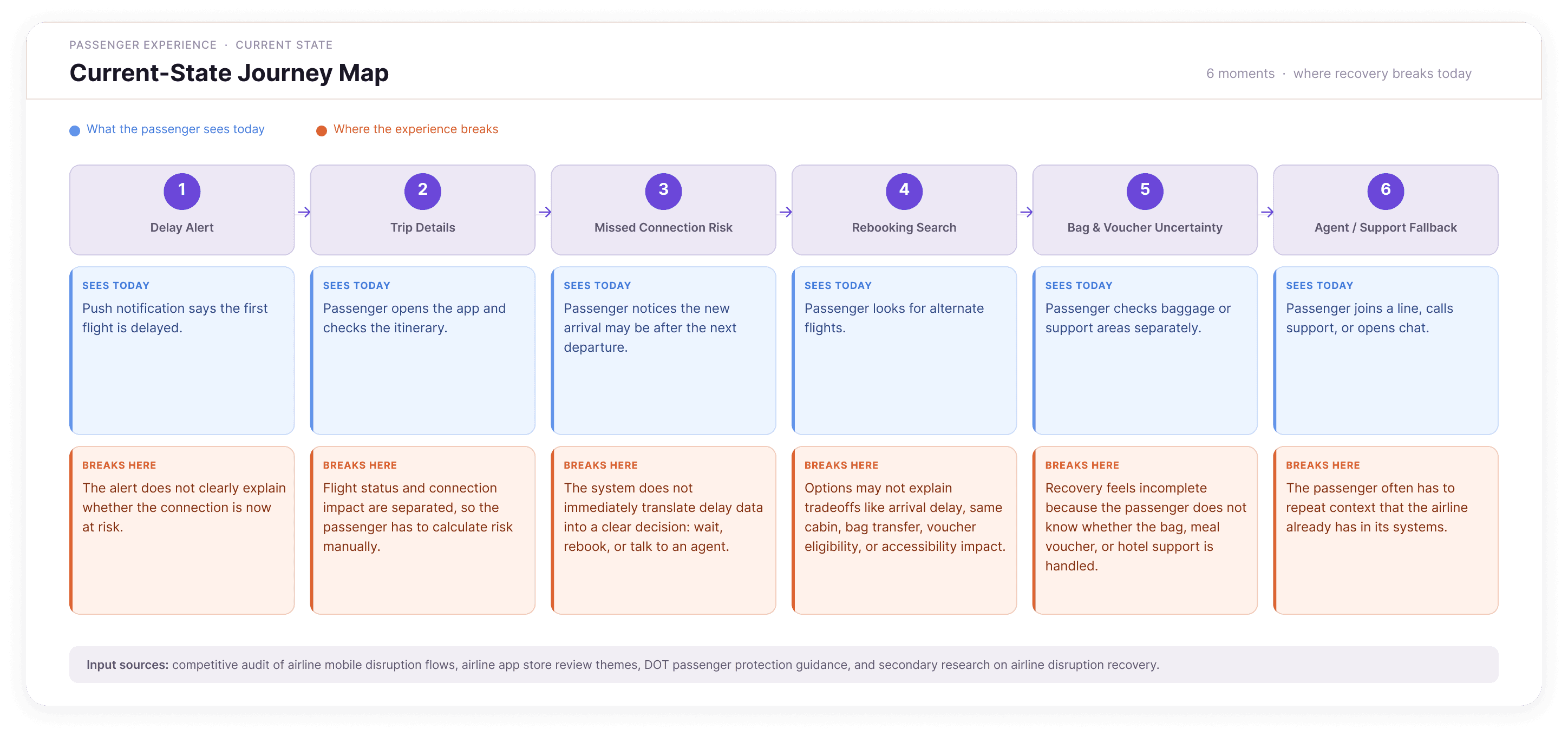
This section shows what happens today before Altitude AI exists. It gives contrast, so your final design feels necessary instead of decorative.
To understand where AI could help, I mapped the current disruption experience from the passenger’s point of view. The issue was not that airlines provide no information; it was that the information arrives in fragments. A delay alert, trip status, rebooking options, baggage status, and voucher eligibility often appear as separate pieces of the journey, forcing passengers to infer what actually matters: “Will I make my connection, and what should I do next?”
TWO USERS, TWO MENTAL MODELS
The same flight disruption creates two very different experiences. For passengers, the problem feels personal and uncertain: “Will I make my connection? What happens to my bag? Do I need to stand in line?” For frontline agents, the problem is operational and high-volume: “Who is affected, who can be resolved automatically, who needs review, and which cases require escalation?” Designing for only one side would create an incomplete system, so I mapped both mental models before designing the passenger app or agent workstation.

DESIGN PRINCIPLES
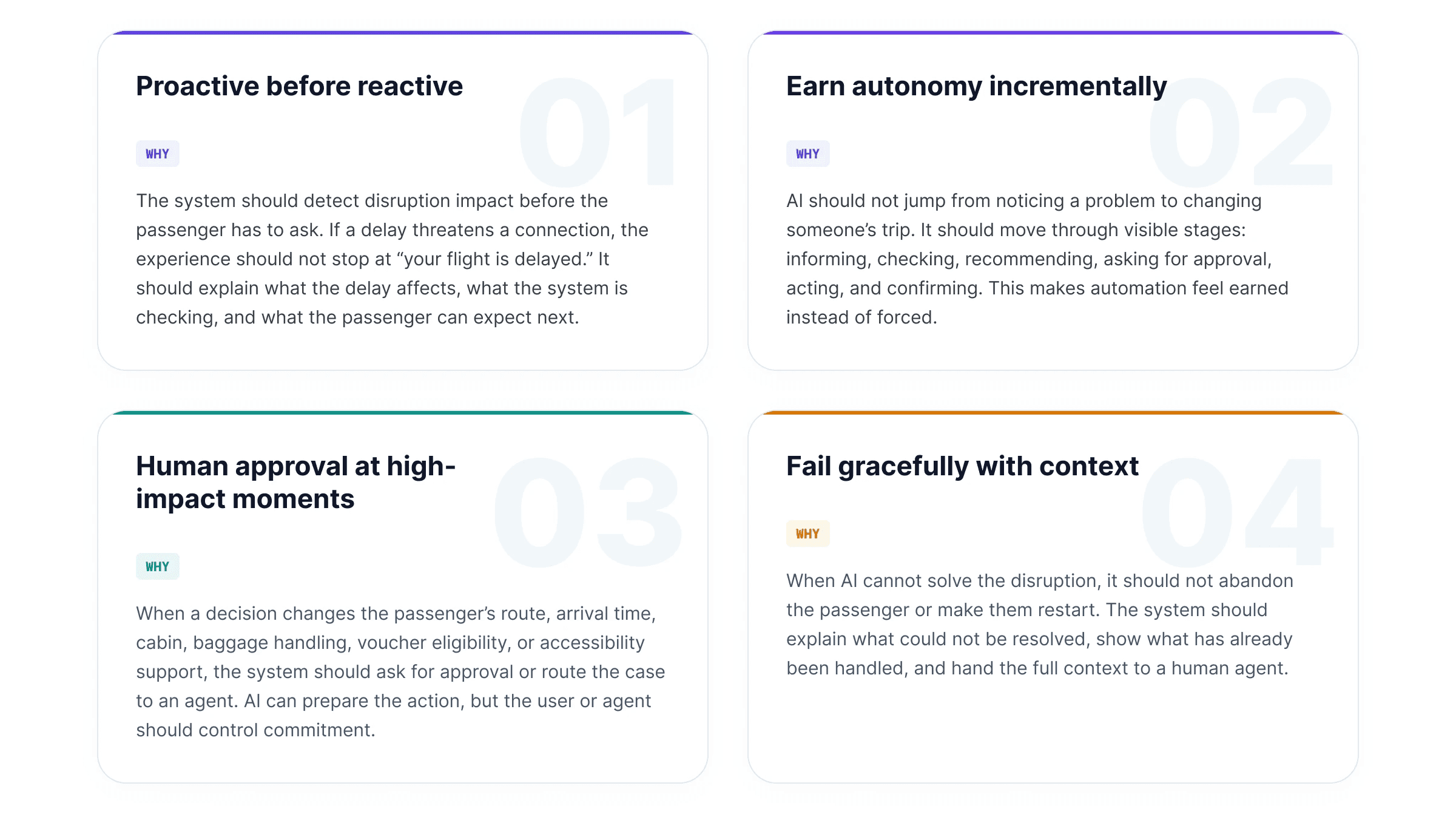
Before designing screens, I defined a set of principles for how AI should behave in a high-stress travel moment. The goal was to avoid designing AI as a black box. Every AI action needed to be visible, understandable, permission-based when necessary, and able to hand off gracefully when the system reached its limit.
PASSENGER SOLUTION
Passenger Experience: From Delay Alert to Resolved Trip
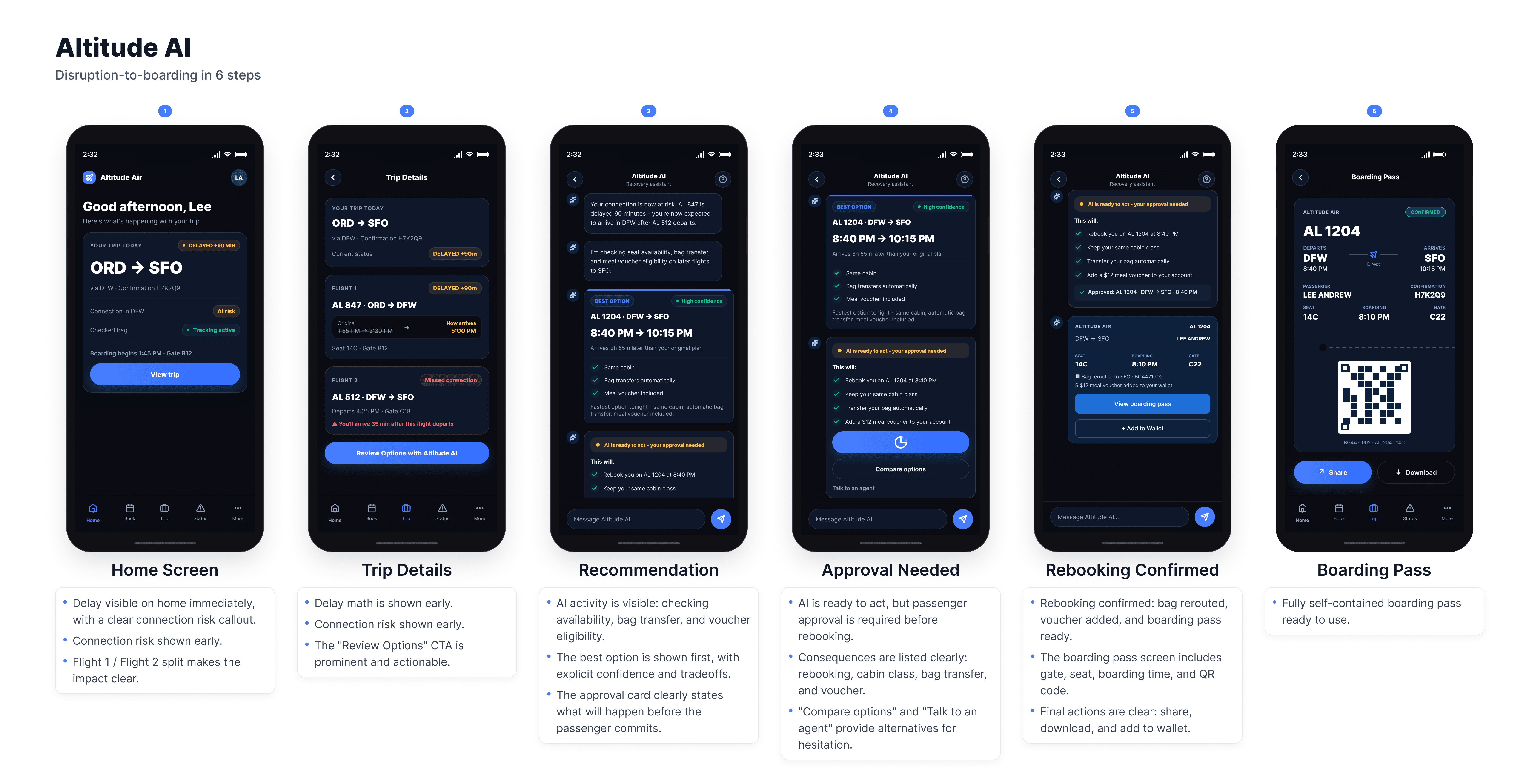
I designed the passenger experience as a guided recovery flow inside the airline app. Instead of making the traveler interpret delay data, search for new flights, check baggage status, and contact support separately, Altitude AI turns the disruption into a clear sequence: understand the risk, review the best option, approve the action, and confirm what was resolved.
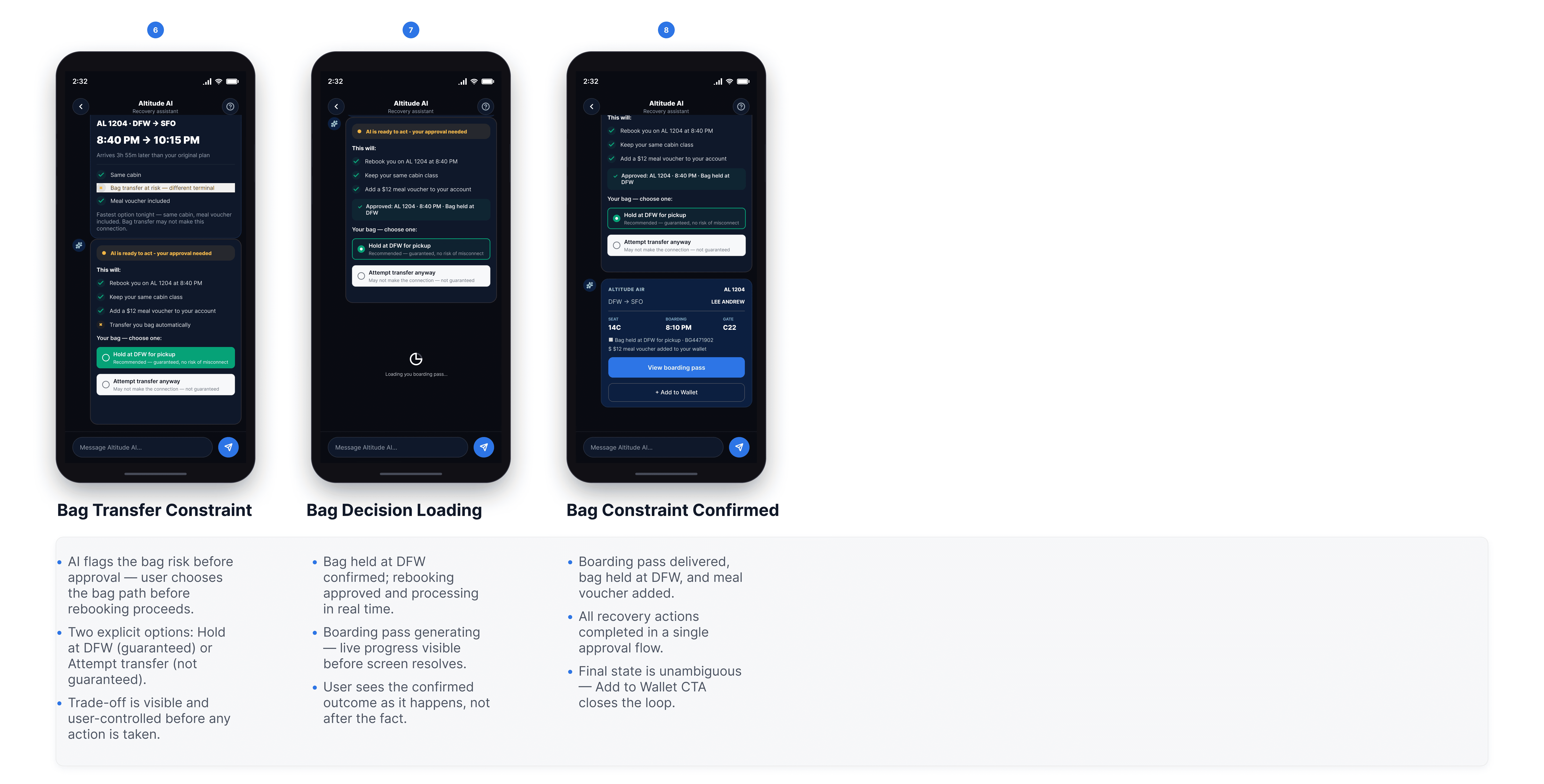
Rebooking possible, bag cannot transfer
I also designed a constraint branch where the passenger can still be rebooked, but the bag cannot transfer safely. Instead of hiding the problem, the system explains the tradeoff and lets the passenger choose how the bag should be handled.
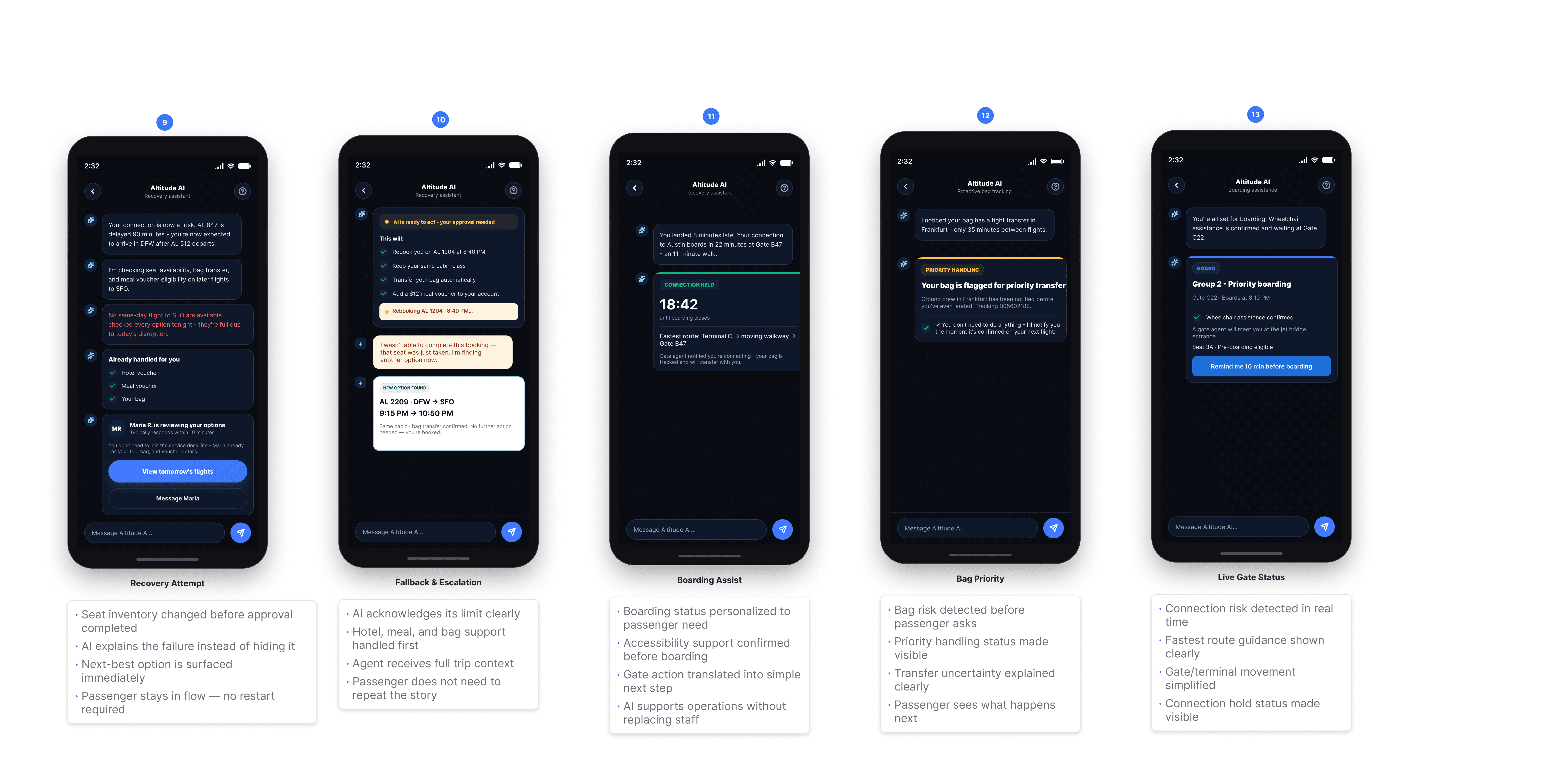
Stress-testing the AI language across edge cases
After designing the primary rebooking flow, I tested the same AI interaction language across harder disruption moments: failed actions, no same-day recovery, gate operations, bag recovery, and tight connections. These screens are not full flows; they show how the system scales when the situation becomes less predictable.
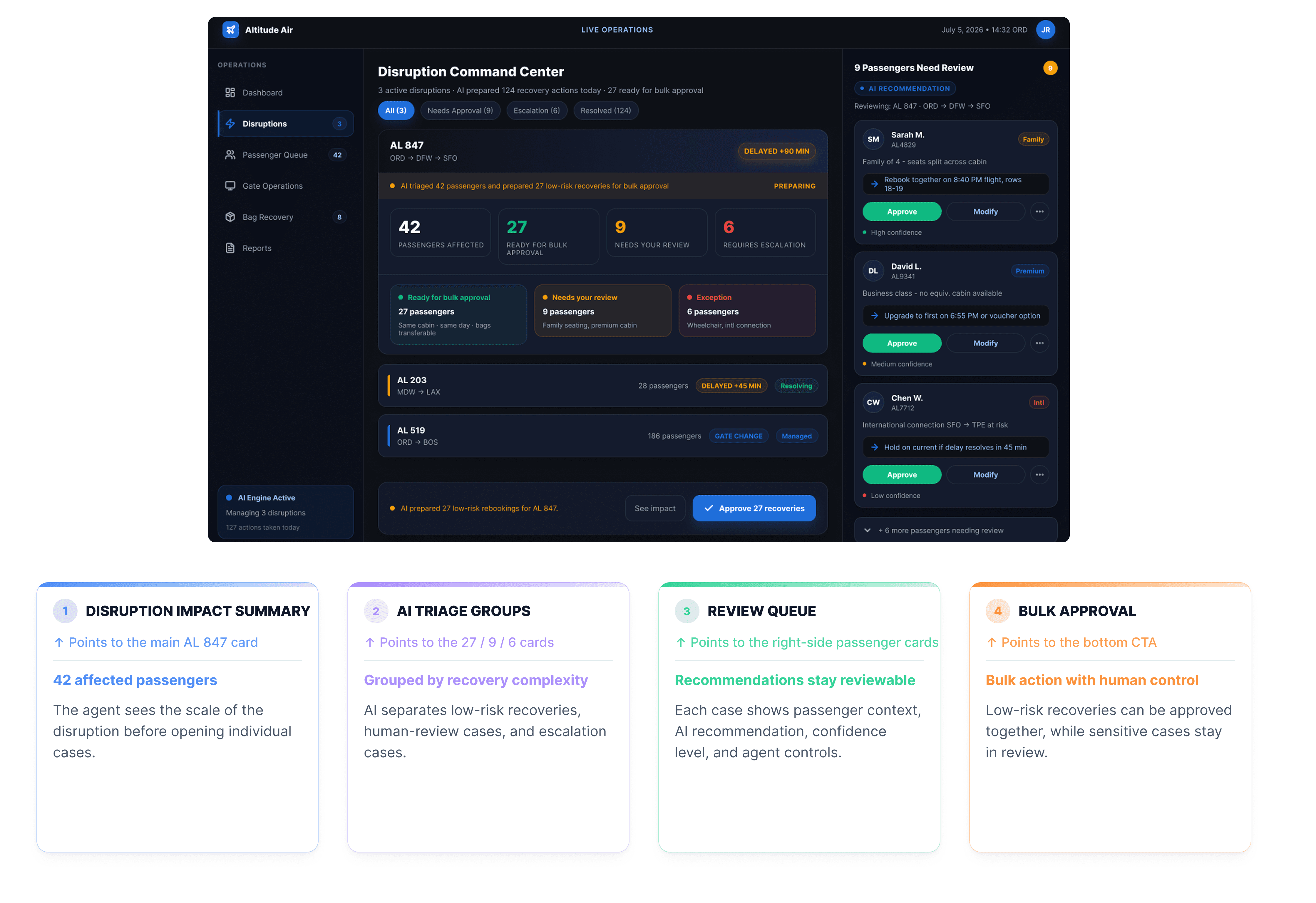
AGENT WORKSTATION
On the agent side, the same disruption becomes an operational triage problem. The workstation groups affected passengers by recovery complexity so agents can approve low-risk recoveries in bulk, review sensitive cases, and escalate exceptions without manually sorting every passenger one by one.
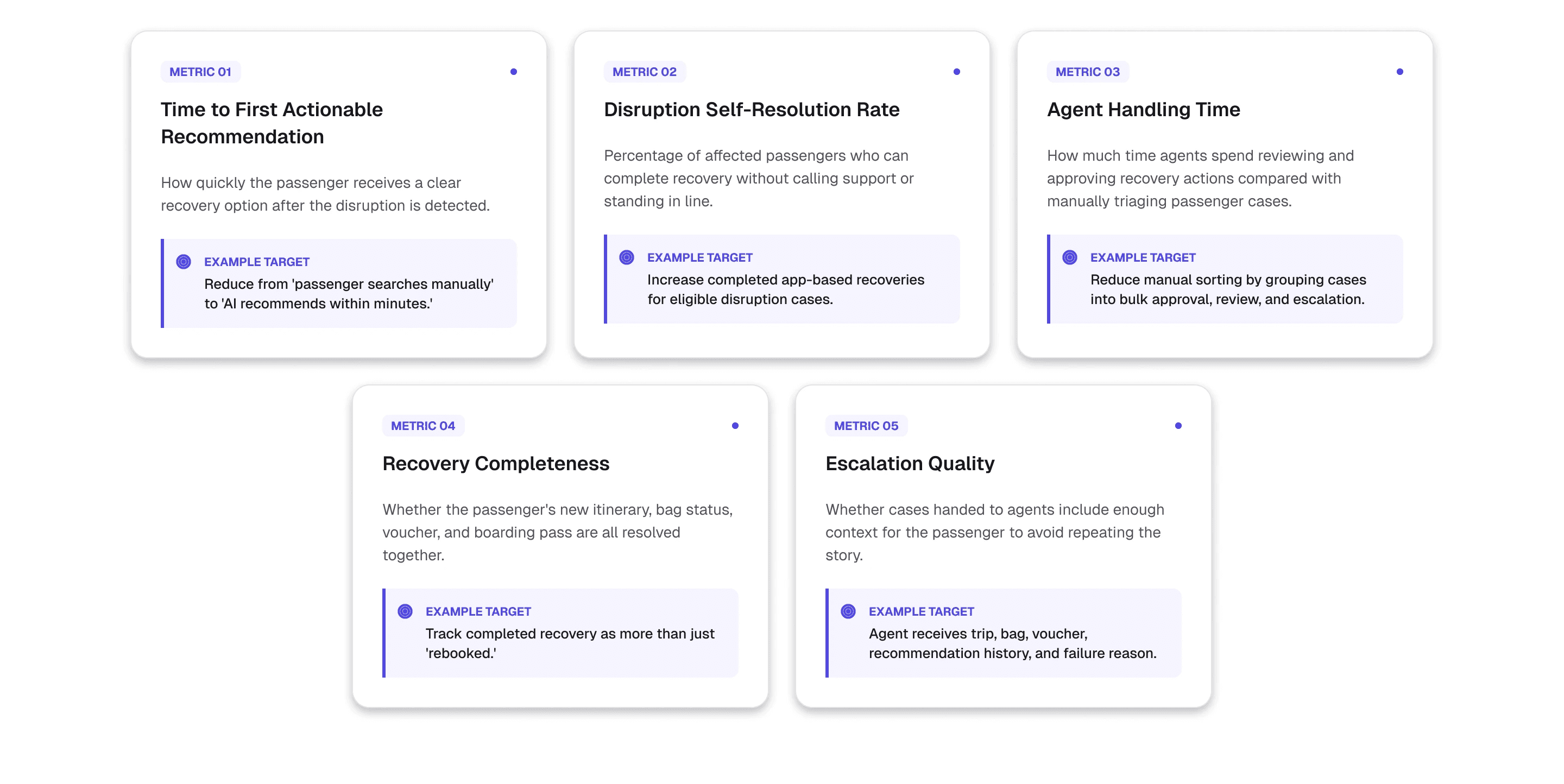
IMPACT- WHAT I WOULD MEASURE + REFLECTION
Because this was a concept project, I defined success as a set of measurable product hypotheses rather than final business outcomes. The goal of Altitude AI would be to reduce passenger uncertainty, shorten disruption recovery time, and help agents focus on exceptions instead of manually sorting every affected traveler.
Reflection
If I had access to airline operations data and real users, I would validate the system with two groups: passengers who recently experienced disruption and frontline agents who handle recovery decisions. For passengers, I would test whether the AI states feel clear, whether approval moments feel trustworthy, and whether the chat-card format reduces uncertainty. For agents, I would test whether the triage groups, confidence labels, and bulk approval model match real operational workflows.
The core design challenge was not making AI more powerful. It was making AI action visible, explainable, and controllable when passengers and agents are under pressure.
Agentic Workflow Design
Agentic AI Recovery System for Airline Disruptions
AI system that helps airline passengers recover from disruptions while giving agents reviewable, controllable AI-recommended actions.
Role
UX Research, Conversation Design, Interaction Design
Tools
Figma, Qualitrics
Type
Independent concept project
Duration
3 Weeks
OVERVIEW
When a flight gets delayed, the airline already knows almost everything it needs to help you — your connection, your bag, your odds of making it. It just has no way to tell you in time.
I designed an AI-powered disruption recovery system for a fictional airline, Altitude Air —one system, two surfaces: a disruption command center for operations agents, and a conversational recovery assistant for passengers, Altitude AI. Same AI reasoning, expressed differently depending on who's looking at it.
THE PROBLEM
Airlines have the data. They don't have the interaction layer to deliver it in time.
7,000 flights cancelled, 1.4M passengers disrupted — Delta's 2024 CrowdStrike outage, when crew-tracking failures forced recovery decisions to be made by hand. Source: Reuters, via Wikipedia →
16,700 flights cancelled in 10 days — Southwest's 2022 holiday collapse, when crew-scheduling software couldn't keep pace once winter storms broke the network. Source: NPR →
148,479 bags mishandled in a single month — November 2025 alone. Passengers with wheelchairs and mobility devices were mishandled at more than double that rate. Source: DOT Air Travel Consumer Report →
So the design problem is narrower than "airlines need better AI." Airlines already have the intelligence. What's missing is an interaction layer that knows how much autonomy to use, when to ask permission, and how to fail without abandoning the person in the middle of it.
RESEARCH
Research signals that shaped the problem
I used secondary research to understand whether airline disruption recovery is mainly an information problem, an operations problem, or an interaction problem. Three signals stood out: passengers increasingly expect mobile self-service, airline recovery operations can break under fragmented systems, and disruption recovery includes baggage, vouchers, and accessibility needs — not just rebooking.
EVIDENCE 01
Mobile is the right passenger surface
78%
want one unified travel app
IATA’s 2025 Global Passenger Survey shows that passengers are increasingly managing their journey through smartphones. One key finding: 78% of passengers want one app combining their digital wallet, passport, and loyalty cards. This supports mobile as the right surface for disruption recovery — but not as proof that passengers want full AI autonomy. The design challenge is to introduce AI gradually, with clear status, explanation, and approval.
IATA Global Passenger Survey 2025
EVIDENCE 02
Recovery breaks when tools are fragmented
17K
flights cancelled in one collapse
Major airline disruptions show how quickly recovery can fail when operational decisions depend on disconnected systems. Delta’s 2024 CrowdStrike-related disruption led to about 7,000 cancelled flights affecting roughly 1.4 million passengers. Southwest’s 2022 holiday collapse showed similar fragility: winter storms combined with outdated crew-scheduling technology contributed to nearly 17,000 cancelled flights.
Reuters · AP News
EVIDENCE 03
Recovery is more than rebooking
88%
want real-time luggage tracking
DOT’s Air Travel Consumer Reports track not only flight delays, but also mishandled baggage, wheelchairs, and scooters. A passenger is not truly recovered if the flight is rebooked but the bag, voucher, or mobility device is unresolved. IATA also found that 88% of passengers would feel more confident if they could track luggage in real time, reinforcing baggage visibility as a core recovery need.
U.S. DOT Air Travel Consumer Reports · IATA GPS 2025
Sources reviewed: IATA Global Passenger Survey 2025; U.S. DOT Air Travel Consumer Reports; Reuters coverage of Delta’s 2024 CrowdStrike disruption; AP News coverage of Southwest’s 2022 holiday operational collapse.
Sources reviewed: IATA Global Passenger Survey 2025; U.S. DOT Air Travel Consumer Reports; Reuters coverage of Delta’s 2024 CrowdStrike disruption; AP News coverage of Southwest’s 2022 holiday operational collapse.
BEFORE STATE/ CURRENT EXPERIECNE AUDIT
This section shows what happens today before Altitude AI exists. It gives contrast, so your final design feels necessary instead of decorative.
To understand where AI could help, I mapped the current disruption experience from the passenger’s point of view. The issue was not that airlines provide no information; it was that the information arrives in fragments. A delay alert, trip status, rebooking options, baggage status, and voucher eligibility often appear as separate pieces of the journey, forcing passengers to infer what actually matters: “Will I make my connection, and what should I do next?”
TWO USERS, TWO MENTAL MODELS
The same flight disruption creates two very different experiences. For passengers, the problem feels personal and uncertain: “Will I make my connection? What happens to my bag? Do I need to stand in line?” For frontline agents, the problem is operational and high-volume: “Who is affected, who can be resolved automatically, who needs review, and which cases require escalation?” Designing for only one side would create an incomplete system, so I mapped both mental models before designing the passenger app or agent workstation.
DESIGN PRINCIPLES
Before designing screens, I defined a set of principles for how AI should behave in a high-stress travel moment. The goal was to avoid designing AI as a black box. Every AI action needed to be visible, understandable, permission-based when necessary, and able to hand off gracefully when the system reached its limit.
PASSENGER SOLUTION
Passenger Experience: From Delay Alert to Resolved Trip
I designed the passenger experience as a guided recovery flow inside the airline app. Instead of making the traveler interpret delay data, search for new flights, check baggage status, and contact support separately, Altitude AI turns the disruption into a clear sequence: understand the risk, review the best option, approve the action, and confirm what was resolved.
Rebooking possible, bag cannot transfer
I also designed a constraint branch where the passenger can still be rebooked, but the bag cannot transfer safely. Instead of hiding the problem, the system explains the tradeoff and lets the passenger choose how the bag should be handled.
Stress-testing the AI language across edge cases
After designing the primary rebooking flow, I tested the same AI interaction language across harder disruption moments: failed actions, no same-day recovery, gate operations, bag recovery, and tight connections. These screens are not full flows; they show how the system scales when the situation becomes less predictable.
AGENT WORKSTATION
On the agent side, the same disruption becomes an operational triage problem. The workstation groups affected passengers by recovery complexity so agents can approve low-risk recoveries in bulk, review sensitive cases, and escalate exceptions without manually sorting every passenger one by one.
IMPACT- WHAT I WOULD MEASURE + REFLECTION
Because this was a concept project, I defined success as a set of measurable product hypotheses rather than final business outcomes. The goal of Altitude AI would be to reduce passenger uncertainty, shorten disruption recovery time, and help agents focus on exceptions instead of manually sorting every affected traveler.
Reflection
If I had access to airline operations data and real users, I would validate the system with two groups: passengers who recently experienced disruption and frontline agents who handle recovery decisions. For passengers, I would test whether the AI states feel clear, whether approval moments feel trustworthy, and whether the chat-card format reduces uncertainty. For agents, I would test whether the triage groups, confidence labels, and bulk approval model match real operational workflows.
The core design challenge was not making AI more powerful. It was making AI action visible, explainable, and controllable when passengers and agents are under pressure.
Agentic Workflow Design
Agentic AI Recovery System for Airline Disruptions
AI system that helps airline passengers recover from disruptions while giving agents reviewable, controllable AI-recommended actions.
Role
UX Research, Conversation Design, Interaction Design
Tools
Figma, Qualitrics
Type
Independent concept project
Duration
3 Weeks
OVERVIEW
When a flight gets delayed, the airline already knows almost everything it needs to help you — your connection, your bag, your odds of making it. It just has no way to tell you in time.
I designed an AI-powered disruption recovery system for a fictional airline, Altitude Air —one system, two surfaces: a disruption command center for operations agents, and a conversational recovery assistant for passengers, Altitude AI. Same AI reasoning, expressed differently depending on who's looking at it.
THE PROBLEM
Airlines have the data. They don't have the interaction layer to deliver it in time.
7,000 flights cancelled, 1.4M passengers disrupted — Delta's 2024 CrowdStrike outage, when crew-tracking failures forced recovery decisions to be made by hand. Source: Reuters, via Wikipedia →
16,700 flights cancelled in 10 days — Southwest's 2022 holiday collapse, when crew-scheduling software couldn't keep pace once winter storms broke the network. Source: NPR →
148,479 bags mishandled in a single month — November 2025 alone. Passengers with wheelchairs and mobility devices were mishandled at more than double that rate. Source: DOT Air Travel Consumer Report →
So the design problem is narrower than "airlines need better AI." Airlines already have the intelligence. What's missing is an interaction layer that knows how much autonomy to use, when to ask permission, and how to fail without abandoning the person in the middle of it.
RESEARCH
Research signals that shaped the problem
I used secondary research to understand whether airline disruption recovery is mainly an information problem, an operations problem, or an interaction problem. Three signals stood out: passengers increasingly expect mobile self-service, airline recovery operations can break under fragmented systems, and disruption recovery includes baggage, vouchers, and accessibility needs — not just rebooking.
EVIDENCE 01
Mobile is the right passenger surface
78%
want one unified travel app
IATA’s 2025 Global Passenger Survey shows that passengers are increasingly managing their journey through smartphones. One key finding: 78% of passengers want one app combining their digital wallet, passport, and loyalty cards. This supports mobile as the right surface for disruption recovery — but not as proof that passengers want full AI autonomy. The design challenge is to introduce AI gradually, with clear status, explanation, and approval.
IATA Global Passenger Survey 2025
EVIDENCE 02
Recovery breaks when tools are fragmented
17K
flights cancelled in one collapse
Major airline disruptions show how quickly recovery can fail when operational decisions depend on disconnected systems. Delta’s 2024 CrowdStrike-related disruption led to about 7,000 cancelled flights affecting roughly 1.4 million passengers. Southwest’s 2022 holiday collapse showed similar fragility: winter storms combined with outdated crew-scheduling technology contributed to nearly 17,000 cancelled flights.
Reuters · AP News
EVIDENCE 03
Recovery is more than rebooking
88%
want real-time luggage tracking
DOT’s Air Travel Consumer Reports track not only flight delays, but also mishandled baggage, wheelchairs, and scooters. A passenger is not truly recovered if the flight is rebooked but the bag, voucher, or mobility device is unresolved. IATA also found that 88% of passengers would feel more confident if they could track luggage in real time, reinforcing baggage visibility as a core recovery need.
U.S. DOT Air Travel Consumer Reports · IATA GPS 2025
Sources reviewed: IATA Global Passenger Survey 2025; U.S. DOT Air Travel Consumer Reports; Reuters coverage of Delta’s 2024 CrowdStrike disruption; AP News coverage of Southwest’s 2022 holiday operational collapse.
Sources reviewed: IATA Global Passenger Survey 2025; U.S. DOT Air Travel Consumer Reports; Reuters coverage of Delta’s 2024 CrowdStrike disruption; AP News coverage of Southwest’s 2022 holiday operational collapse.
BEFORE STATE/ CURRENT EXPERIECNE AUDIT
This section shows what happens today before Altitude AI exists. It gives contrast, so your final design feels necessary instead of decorative.
To understand where AI could help, I mapped the current disruption experience from the passenger’s point of view. The issue was not that airlines provide no information; it was that the information arrives in fragments. A delay alert, trip status, rebooking options, baggage status, and voucher eligibility often appear as separate pieces of the journey, forcing passengers to infer what actually matters: “Will I make my connection, and what should I do next?”
TWO USERS, TWO MENTAL MODELS
The same flight disruption creates two very different experiences. For passengers, the problem feels personal and uncertain: “Will I make my connection? What happens to my bag? Do I need to stand in line?” For frontline agents, the problem is operational and high-volume: “Who is affected, who can be resolved automatically, who needs review, and which cases require escalation?” Designing for only one side would create an incomplete system, so I mapped both mental models before designing the passenger app or agent workstation.
DESIGN PRINCIPLES
Before designing screens, I defined a set of principles for how AI should behave in a high-stress travel moment. The goal was to avoid designing AI as a black box. Every AI action needed to be visible, understandable, permission-based when necessary, and able to hand off gracefully when the system reached its limit.
PASSENGER SOLUTION
Passenger Experience: From Delay Alert to Resolved Trip
I designed the passenger experience as a guided recovery flow inside the airline app. Instead of making the traveler interpret delay data, search for new flights, check baggage status, and contact support separately, Altitude AI turns the disruption into a clear sequence: understand the risk, review the best option, approve the action, and confirm what was resolved.
Rebooking possible, bag cannot transfer
I also designed a constraint branch where the passenger can still be rebooked, but the bag cannot transfer safely. Instead of hiding the problem, the system explains the tradeoff and lets the passenger choose how the bag should be handled.
Stress-testing the AI language across edge cases
After designing the primary rebooking flow, I tested the same AI interaction language across harder disruption moments: failed actions, no same-day recovery, gate operations, bag recovery, and tight connections. These screens are not full flows; they show how the system scales when the situation becomes less predictable.
AGENT WORKSTATION
On the agent side, the same disruption becomes an operational triage problem. The workstation groups affected passengers by recovery complexity so agents can approve low-risk recoveries in bulk, review sensitive cases, and escalate exceptions without manually sorting every passenger one by one.
IMPACT- WHAT I WOULD MEASURE + REFLECTION
Because this was a concept project, I defined success as a set of measurable product hypotheses rather than final business outcomes. The goal of Altitude AI would be to reduce passenger uncertainty, shorten disruption recovery time, and help agents focus on exceptions instead of manually sorting every affected traveler.
Reflection
If I had access to airline operations data and real users, I would validate the system with two groups: passengers who recently experienced disruption and frontline agents who handle recovery decisions. For passengers, I would test whether the AI states feel clear, whether approval moments feel trustworthy, and whether the chat-card format reduces uncertainty. For agents, I would test whether the triage groups, confidence labels, and bulk approval model match real operational workflows.
The core design challenge was not making AI more powerful. It was making AI action visible, explainable, and controllable when passengers and agents are under pressure.