Design Ethics
Healthcare AI Interaction Patterns
An AI interaction pattern library for symptom intake, wearable context, and urgency routing — governing the patient-to-clinician handoff in enterprise healthcare workflows.
Role
Responsible AI Researcher
Tools
Figma and Notion
Type
Independent Case Study
Duration
3 months
The problem between the patient and the clinician
When a patient feels unwell and reaches for their phone, two things happen at the same time.
They open an app or send a message. Somewhere else, a clinician's inbox receives one more entry that may or may not need urgent attention.
Neither person is doing anything wrong. The problem is the handoff.
Patients describe symptoms the way they experience them in fragments, in everyday language, shaped by anxiety, uncertainty, or understatement. They say things like "I feel weird," "my chest feels tight," "I've been really tired," or "something just feels off."
Clinicians receive those messages without the context that would help them quickly understand what matters, what is missing, and what needs action now.
AI seems like an obvious bridge. But many AI health tools fail in two ways:
They ask too many clinical questions too early.
Or they give generic advice that does not help the clinician prioritize.

This project started with a different question:
What if AI did not try to diagnose the patient, but instead helped create a better handoff between the patient and clinician?
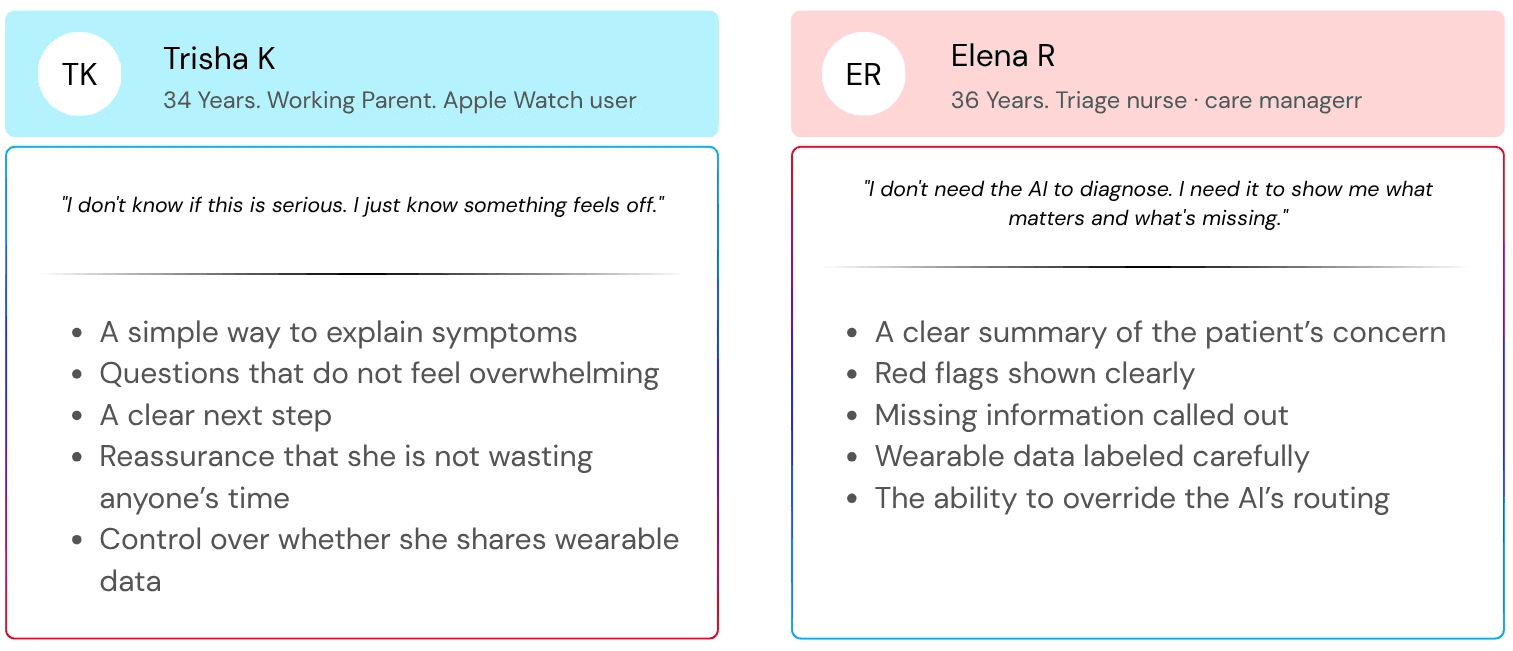
The two people this system is for
The handoff has two sides. Both need to be designed for. Before defining any pattern, the system needed to be grounded in the people whose daily work it would change — or fail.
What shaped the project
This project did not begin with primary research. It began with design experience, pattern observation, and secondary research themes that had already shaped how I think about AI in clinical workflows.
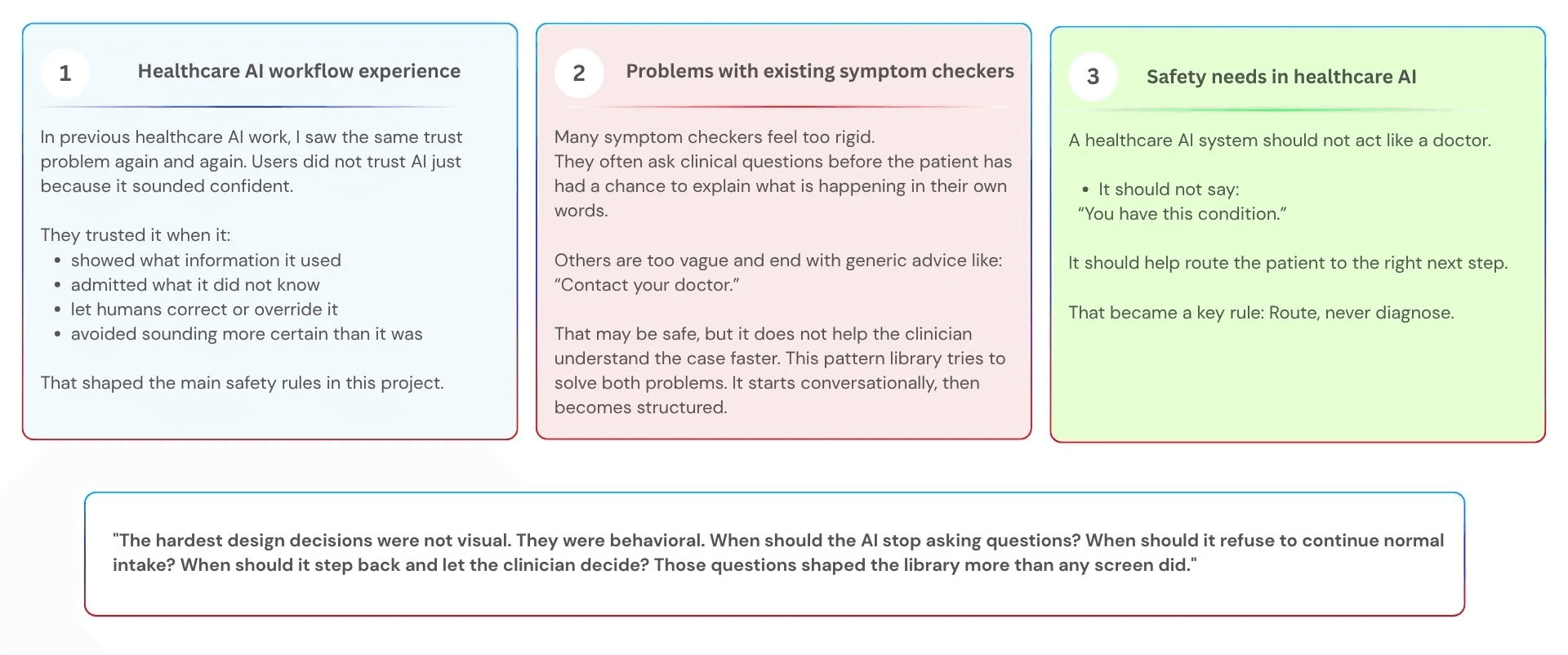
Here’s how I navigated complexity
The first instinct with this problem is to design an app. A patient-facing chatbot. A symptom checker. A triage flow. But that framing misses the deeper problem.
So I designed a pattern library instead.
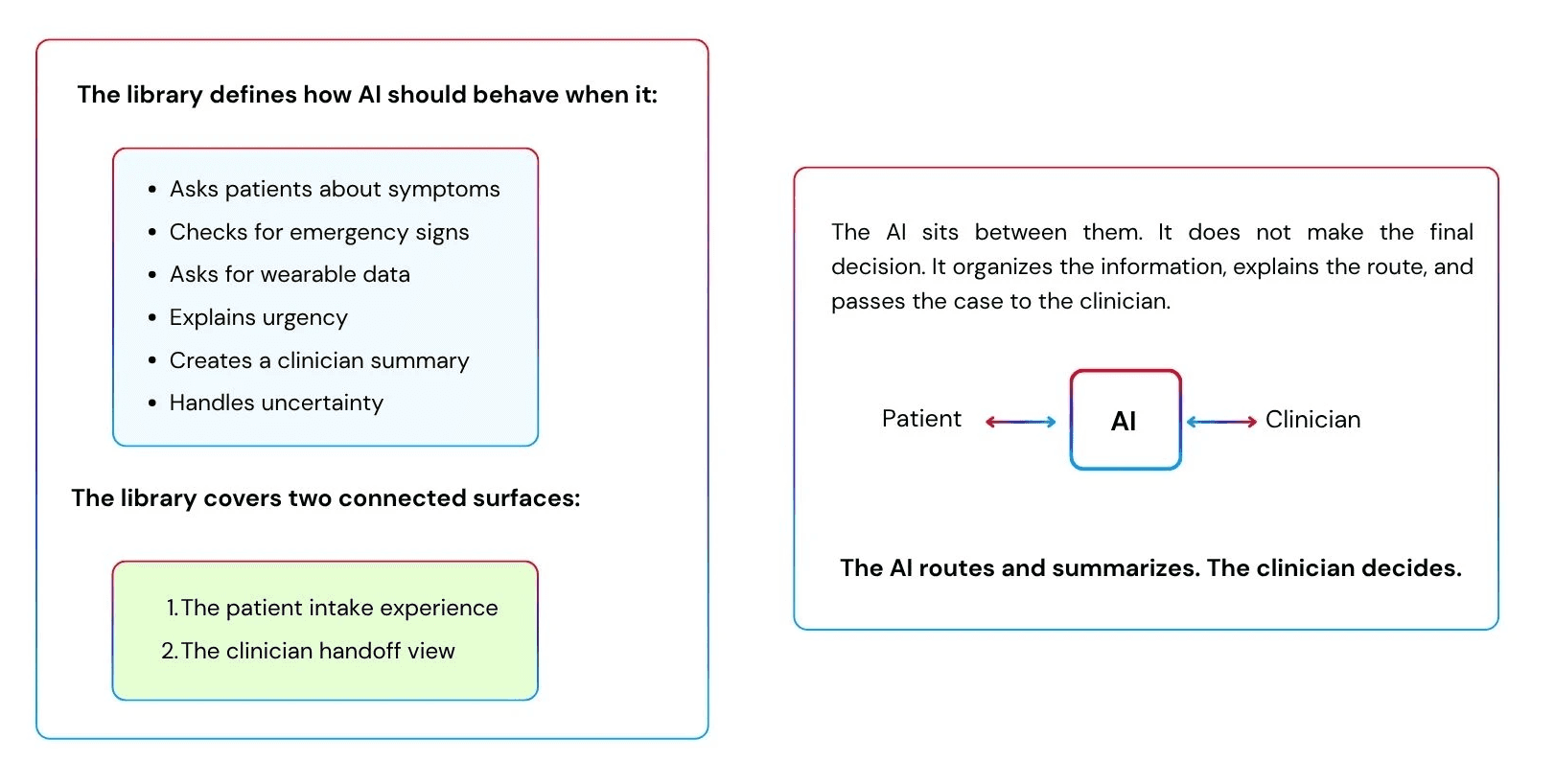
Visual Idea:
Pattern Library
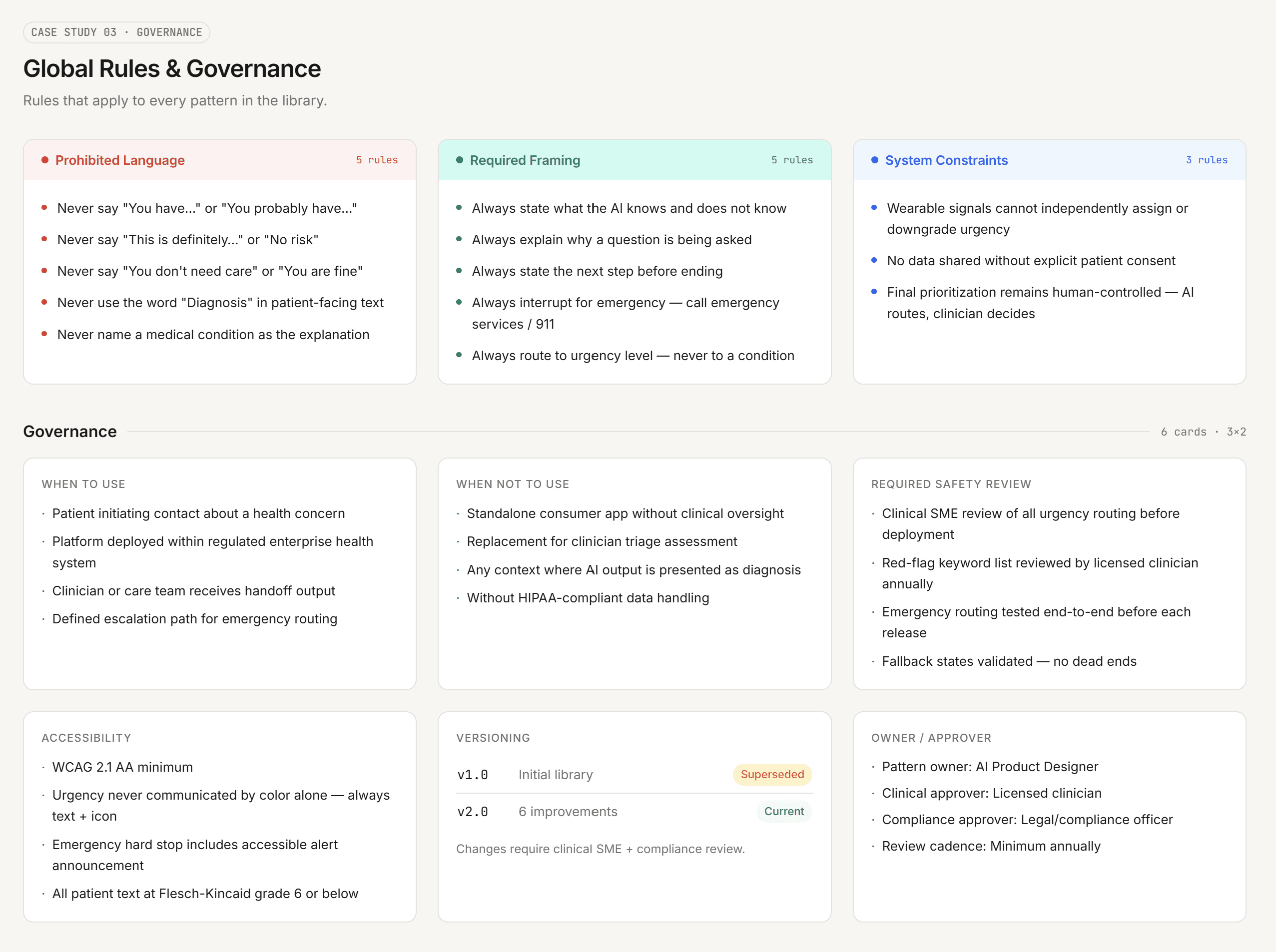
Golden Rules
The design principles
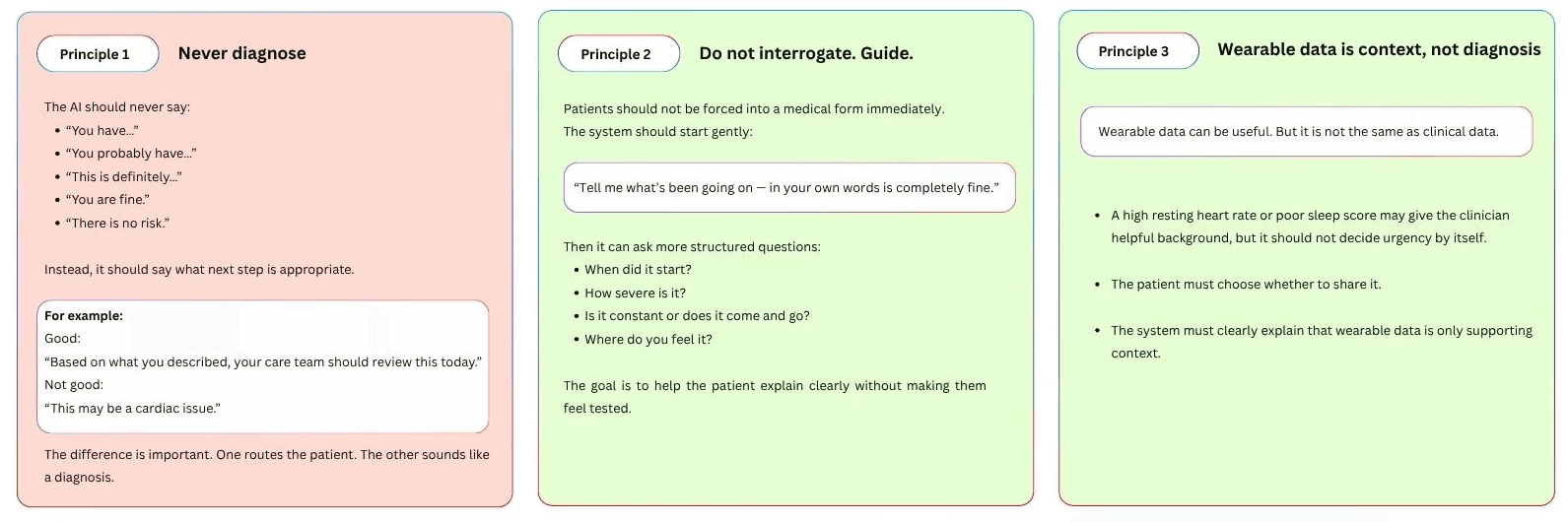
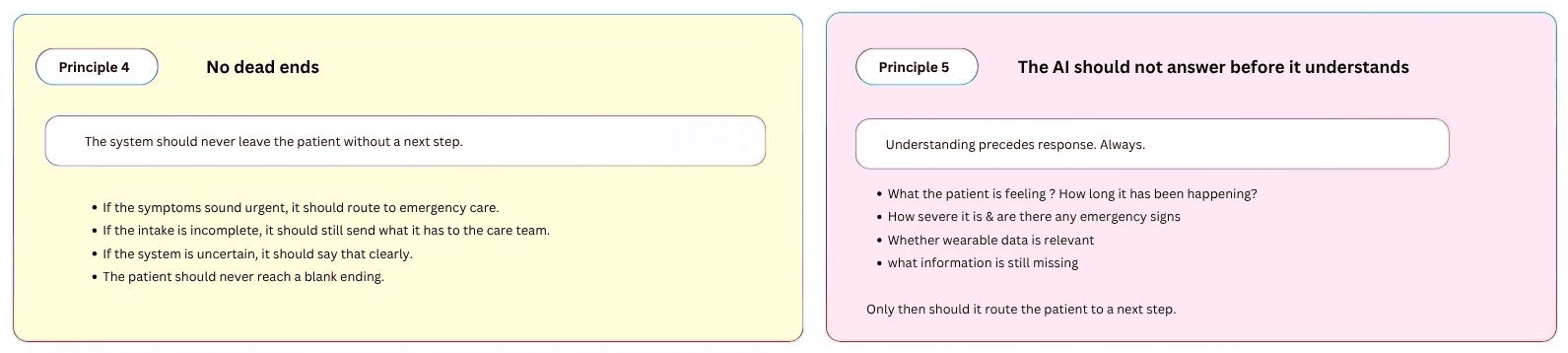
Before designing any individual pattern, five behavioral rules had to be locked. In healthcare AI, tone is not enough. A friendly message can still be unsafe if it implies certainty the system does not have.
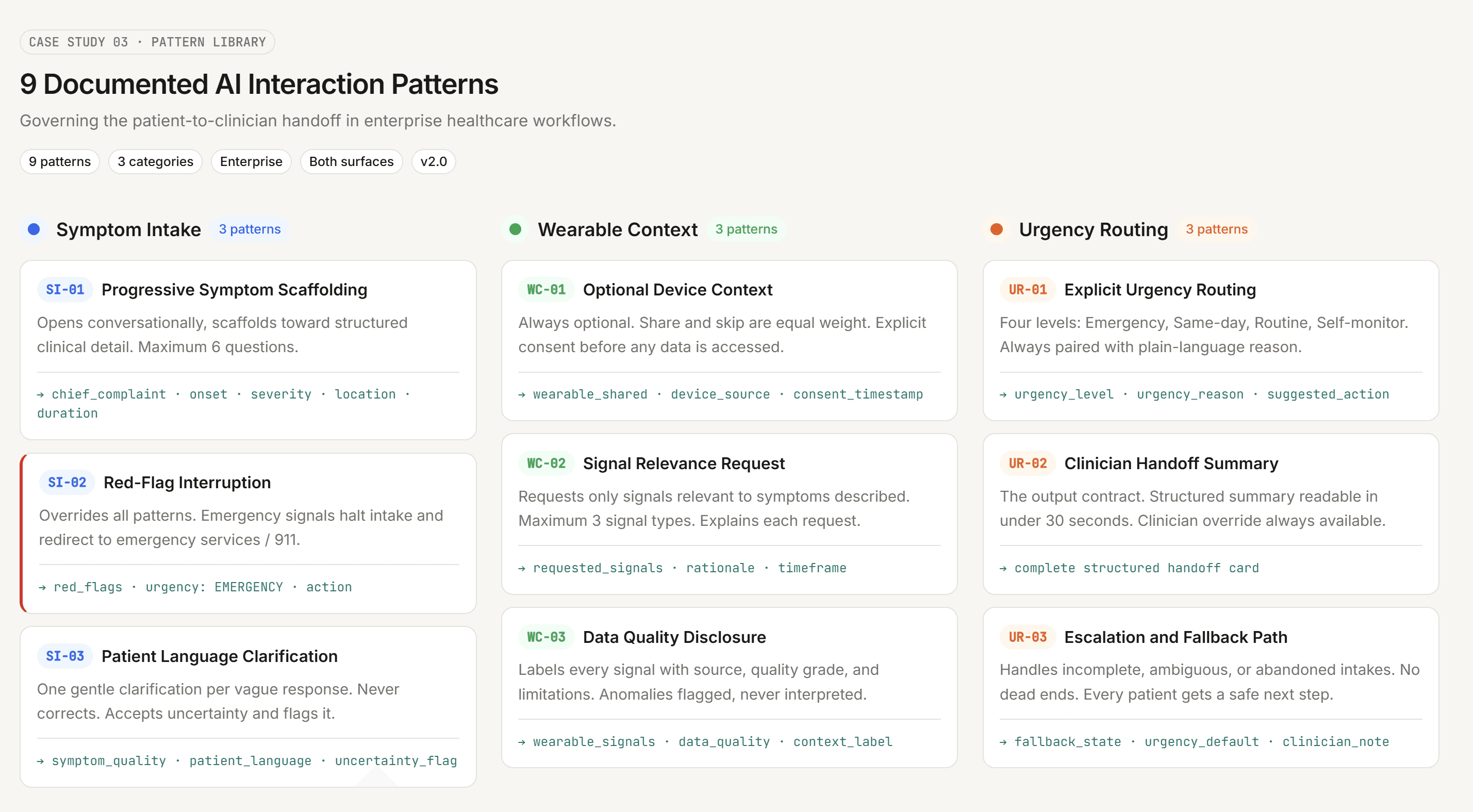
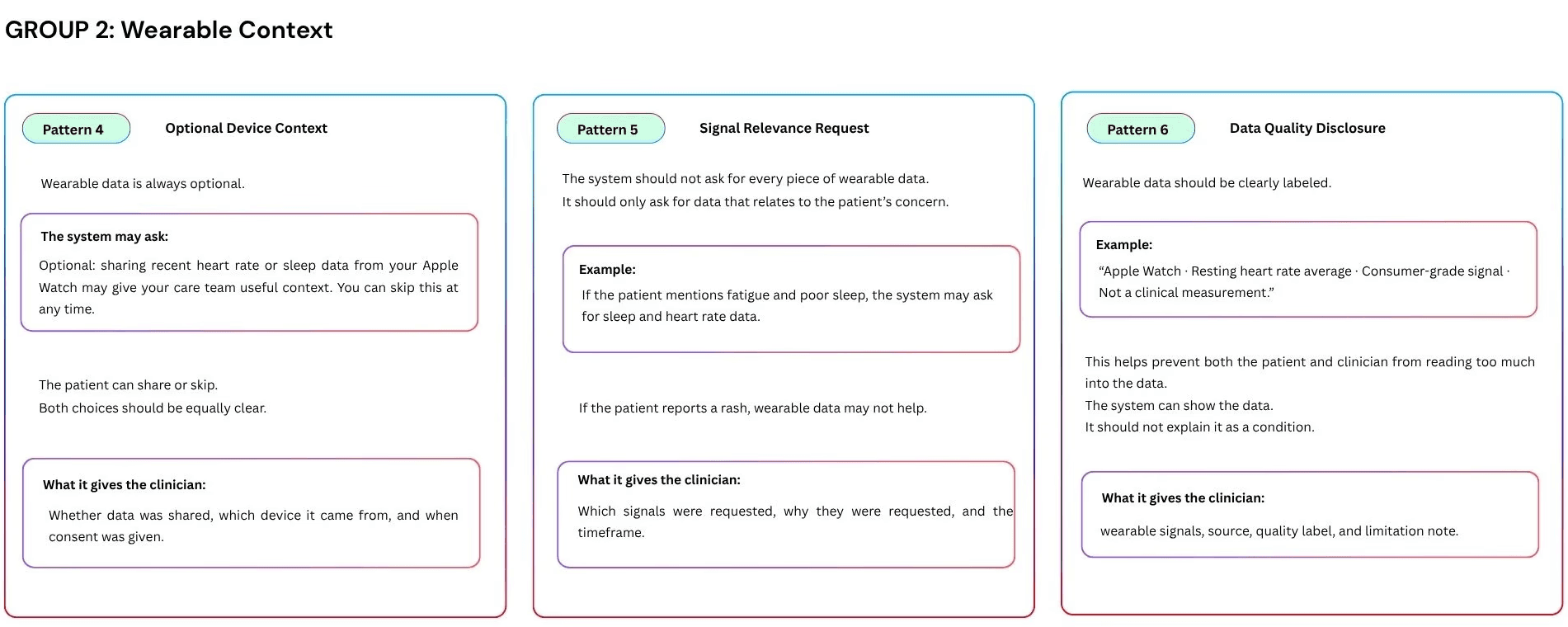
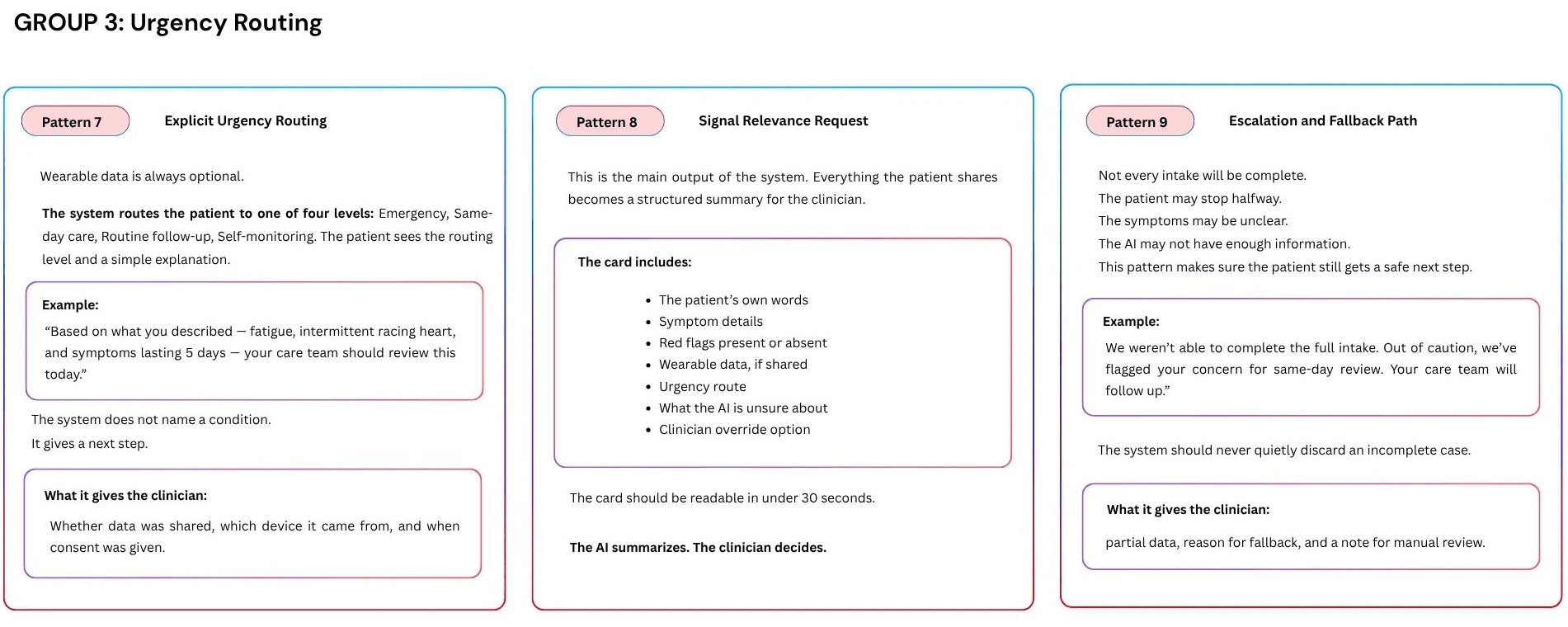
The 9 patterns
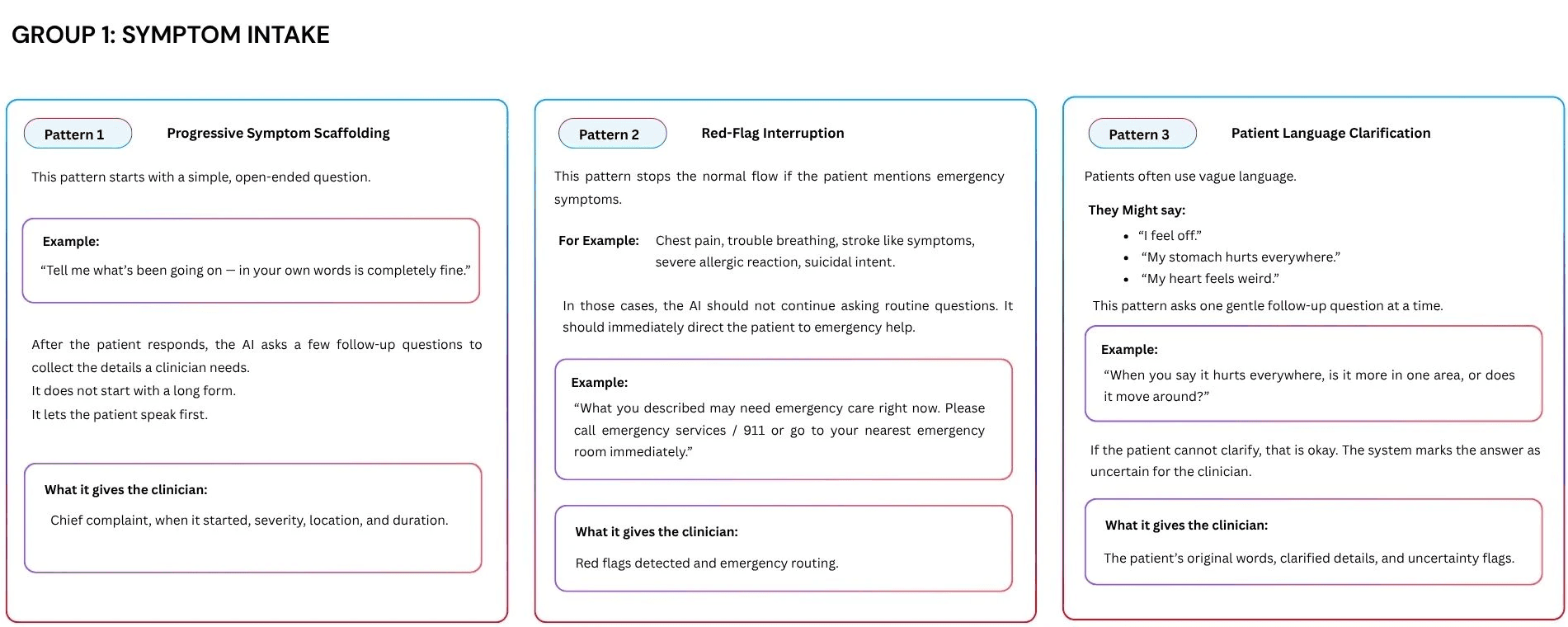
The final library includes 9 patterns across 3 groups.
What the prototype shows
I created a small reference flow to show how the pattern library could work in practice.
This is not a full app.
It is an example implementation of the patterns.
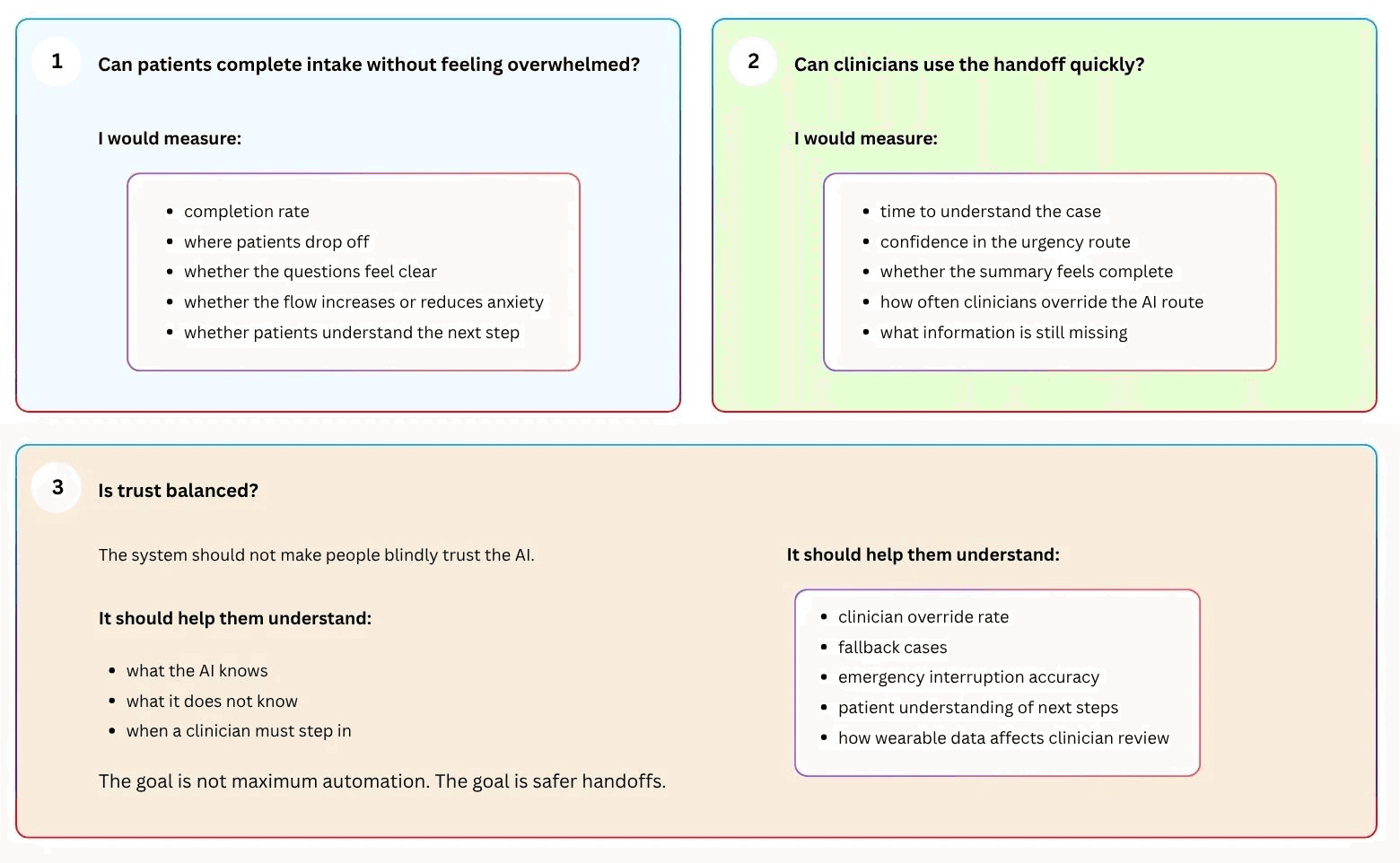
What I would test next
This project has not been tested with users yet. The next step would be to test the patterns with both patients and clinicians. I would focus on three questions.
What this project taught me
Designing healthcare AI is not about making the system sound more intelligent. It is about making the system behave more responsibly.
The hardest decisions in this project were behavioral, not visual. When should the AI stop asking questions? When should it interrupt the normal flow entirely? When should it show uncertainty rather than a confident answer? Those questions shaped the library more than any screen did. The most important design work happened before the first wireframe.
Those questions shaped the project more than any screen did.
The final result is a pattern system for one sensitive moment in healthcare:
When a person asks for help, and someone else has to decide how urgent that help is.
Good AI design should not make that moment feel automated.
It should make it clearer, safer, and easier to act on.


Design Ethics
Healthcare AI Interaction Patterns
An AI interaction pattern library for symptom intake, wearable context, and urgency routing — governing the patient-to-clinician handoff in enterprise healthcare workflows.
Role
Responsible AI Researcher
Tools
Figma and Notion
Type
Independent Case Study
Duration
3 months
The problem between the patient and the clinician
When a patient feels unwell and reaches for their phone, two things happen at the same time.
They open an app or send a message. Somewhere else, a clinician's inbox receives one more entry that may or may not need urgent attention.
Neither person is doing anything wrong. The problem is the handoff.
Patients describe symptoms the way they experience them in fragments, in everyday language, shaped by anxiety, uncertainty, or understatement. They say things like "I feel weird," "my chest feels tight," "I've been really tired," or "something just feels off."
Clinicians receive those messages without the context that would help them quickly understand what matters, what is missing, and what needs action now.
AI seems like an obvious bridge. But many AI health tools fail in two ways:
They ask too many clinical questions too early.
Or they give generic advice that does not help the clinician prioritize.
This project started with a different question:
What if AI did not try to diagnose the patient, but instead helped create a better handoff between the patient and clinician?
The two people this system is for
The handoff has two sides. Both need to be designed for. Before defining any pattern, the system needed to be grounded in the people whose daily work it would change — or fail.
What shaped the project
This project did not begin with primary research. It began with design experience, pattern observation, and secondary research themes that had already shaped how I think about AI in clinical workflows.
Here’s how I navigated complexity
The first instinct with this problem is to design an app. A patient-facing chatbot. A symptom checker. A triage flow. But that framing misses the deeper problem.
So I designed a pattern library instead.
Visual Idea:
Pattern Library
Golden Rules
The design principles
Before designing any individual pattern, five behavioral rules had to be locked. In healthcare AI, tone is not enough. A friendly message can still be unsafe if it implies certainty the system does not have.
The 9 patterns
The final library includes 9 patterns across 3 groups.
What the prototype shows
I created a small reference flow to show how the pattern library could work in practice.
This is not a full app.
It is an example implementation of the patterns.
What I would test next
This project has not been tested with users yet. The next step would be to test the patterns with both patients and clinicians. I would focus on three questions.
What this project taught me
Designing healthcare AI is not about making the system sound more intelligent. It is about making the system behave more responsibly.
The hardest decisions in this project were behavioral, not visual. When should the AI stop asking questions? When should it interrupt the normal flow entirely? When should it show uncertainty rather than a confident answer? Those questions shaped the library more than any screen did. The most important design work happened before the first wireframe.
Those questions shaped the project more than any screen did.
The final result is a pattern system for one sensitive moment in healthcare:
When a person asks for help, and someone else has to decide how urgent that help is.
Good AI design should not make that moment feel automated.
It should make it clearer, safer, and easier to act on.
Design Ethics
Healthcare AI Interaction Patterns
An AI interaction pattern library for symptom intake, wearable context, and urgency routing — governing the patient-to-clinician handoff in enterprise healthcare workflows.
Role
Responsible AI Researcher
Tools
Figma and Notion
Type
Independent Case Study
Duration
3 months
The problem between the patient and the clinician
When a patient feels unwell and reaches for their phone, two things happen at the same time.
They open an app or send a message. Somewhere else, a clinician's inbox receives one more entry that may or may not need urgent attention.
Neither person is doing anything wrong. The problem is the handoff.
Patients describe symptoms the way they experience them in fragments, in everyday language, shaped by anxiety, uncertainty, or understatement. They say things like "I feel weird," "my chest feels tight," "I've been really tired," or "something just feels off."
Clinicians receive those messages without the context that would help them quickly understand what matters, what is missing, and what needs action now.
AI seems like an obvious bridge. But many AI health tools fail in two ways:
They ask too many clinical questions too early.
Or they give generic advice that does not help the clinician prioritize.
This project started with a different question:
What if AI did not try to diagnose the patient, but instead helped create a better handoff between the patient and clinician?
The two people this system is for
The handoff has two sides. Both need to be designed for. Before defining any pattern, the system needed to be grounded in the people whose daily work it would change — or fail.
What shaped the project
This project did not begin with primary research. It began with design experience, pattern observation, and secondary research themes that had already shaped how I think about AI in clinical workflows.
Here’s how I navigated complexity
The first instinct with this problem is to design an app. A patient-facing chatbot. A symptom checker. A triage flow. But that framing misses the deeper problem.
So I designed a pattern library instead.
Visual Idea:
Pattern Library
Golden Rules
The design principles
Before designing any individual pattern, five behavioral rules had to be locked. In healthcare AI, tone is not enough. A friendly message can still be unsafe if it implies certainty the system does not have.
The 9 patterns
The final library includes 9 patterns across 3 groups.
What the prototype shows
I created a small reference flow to show how the pattern library could work in practice.
This is not a full app.
It is an example implementation of the patterns.
What I would test next
This project has not been tested with users yet. The next step would be to test the patterns with both patients and clinicians. I would focus on three questions.
What this project taught me
Designing healthcare AI is not about making the system sound more intelligent. It is about making the system behave more responsibly.
The hardest decisions in this project were behavioral, not visual. When should the AI stop asking questions? When should it interrupt the normal flow entirely? When should it show uncertainty rather than a confident answer? Those questions shaped the library more than any screen did. The most important design work happened before the first wireframe.
Those questions shaped the project more than any screen did.
The final result is a pattern system for one sensitive moment in healthcare:
When a person asks for help, and someone else has to decide how urgent that help is.
Good AI design should not make that moment feel automated.
It should make it clearer, safer, and easier to act on.